
Canon EOS Rebel XSi / 450D Review


Once again, Canon releases a Rebel X** / **0D model that has feature improvements, including a higher resolution sensor, over the current higher end *0D model. We saw this when the EOS Rebel XTi was released while the EOS 30D was current. At that time, the 30D remained my strong preference. This time, my choice is not as clear.
The first thing I noticed when I picked up the Canon EOS Rebel XSi / 450D was that the feel of the grip has been majorly improved over the XTi / 400D. However, the actual physical changes are minor. Basically, the big difference for me is that the fingertip portion of the grip is recessed slightly farther up the body (closer to the self-timer lamp). That translates to my pinky fitting on the grip - which gives me much more control over the camera body. Of course, I have a medium-sized male hand - this change may not be enough for those with very large hands - and may not matter to those whose hands fit the prior body style. The rubberized front half of the grip makes the hold even more sure - and it feels better in my hand. So, the improved grip is a good start for me.
There are many additional body changes incorporated into the XSi / 450D. Hover your mouse over the links below the following picture to compare the XSi back with its predecessor, the XTi / 400D, and the 40D. I included Canon's current high end point and shoot model, the PowerShot G9, for comparison as well.

The in-your-face change on the back of the Rebel XSi (North America), Kiss X2 (Japan) or 450D (the rest of the world) (Canon - please stop using different names for the same product) is the significantly larger 3" LCD. The display is very nice - though I still cannot see the borders of the histogram when in bright light (just like on the rest of Canon's recent 3" LCDs). The larger LCD displaced the entire row of left-side buttons, which found new homes above the LCD and below the cross keys. As with using any new DSLR, it takes a little time to learn where the functions reside, but I like the new locations better overall. The recessed (for safety reasons I'm sure) erase button is one I'm still learning to find quickly. The overall shape of the XTi / 450D is more-rounded and attractive. We want our pictures to look great, why not have a great looking camera to take them with?
Even the colors of the LCD-displayed information are now customizable - four options are available and settable in a menu. The setting active for changing with the main dial is now outlined for visual indication (though not shown above). In other words, in M mode, the current shutter speed is outlined until the Av button is pressed. Then the current aperture is outlined.
Additional aesthetic improvement can be seen in the top-view comparison below. Hover your mouse over the links below to compare the Canon EOS Rebel XSi / 450D (with a Canon EF-S 18-55mm IS Lens attached) to the Canon EOS Rebel XTi / 400D (with a Canon EF-S 18-55mm II Lens attached).

The XSi / 450D body has a smoother and more-rounded shape with better-hidden seams compared to the XTi / 450D - it takes on a more refined look. Also visible in the top view image is the new ISO button location (formerly located on the back). This is a very nice change that makes Canon's DSLR bodies more consistent in their functionality. The ISO setting is also visible in the viewfinder - which has itself been enlarged. These all are very nice improvements.
| Model | Body Dimensions | CIPA Weight | |
|---|---|---|---|
| Canon PowerShot G1 X | 4.6 x 3.2 x 2.6" | (116.7 x 80.5 x 64.7mm) | 18.8 oz (534g) |
| Canon PowerShot G12 | 4.4 x 3.0 x 1.9" | (112.1 x 76.2 x 48.3mm) | 13.7 oz (389g) |
| Canon PowerShot G9 | 4.2 x 2.8 x 1.7" | (106.4 x 71.9 x 42.5mm) | 12.9 oz (365g) |
| Canon EOS M | 4.3 x 2.6 x 1.3" | (108.6 x 66.5 x 32.3mm) | 10.5 oz (298g) |
| Canon EOS Rebel SL1 / 100D | 4.6 x 3.6 x 2.7" | (116.8 x 90.7 x 69.4mm) | 14.4 oz (407g) |
| Canon EOS Rebel T5i / 700D | 5.2 x 3.9 x 3.1" | (133.1 x 99.8 x 78.8mm) | 20.5 oz (580g) |
| Canon EOS Rebel T4i / 650D | 5.2 x 3.9 x 3.1" | (133.1 x 99.8 x 78.8mm) | 20.3 oz (575g) |
| Canon EOS Rebel T3i / 600D | 5.2 x 3.9 x 3.1" | (133.1 x 99.5 x 79.7mm) | 20.1 oz (570g) |
| Canon EOS Rebel T2i / 550D | 5.1 x 3.8 x 2.4" | (128.8 x 97.5 x 61.9mm) | 18.7 oz (530g) |
| Canon EOS Rebel T1i / 500D | 5.1 x 3.8 x 2.4" | (128.8 x 97.5 x 61.9mm) | 18.6 oz (527g) |
| Canon EOS Rebel T5 / 1200D | 5.1 x 3.9 x 3.1" | (129.6 x 99.7 x 77.9 mm) | 16.9 oz (480g) |
| Canon EOS Rebel T3 / 1100D | 5.1 x 3.9 x 3.1" | (129.9 x 99.7 x 77.9mm) | 17.5 oz (495g) |
| Canon EOS Rebel XSi / 450D | 5.1 x 3.8 x 2.4" | (128.8 x 97.5 x 61.9mm) | 18.4 oz (522g) |
| Canon EOS Rebel XS / 1000D | 5.0 x 3.8 x 2.4" | (126.1 x 97.5 x 61.9mm) | 17.5 oz (497g) |
| Canon EOS Rebel XTi / 400D | 5.0 x 3.7 x 2.6" | (127 x 94 x 65mm) | 19.9 oz (564g) |
| Canon EOS Rebel XT / 350D | 5.0 x 3.7 x 2.6" | (127 x 94 x 64mm) | 19.0 oz (539g) |
| Canon EOS 70D | 5.5 x 4.1 x 3.1" | (139.0 x 104.3 x 78.5mm) | 26.7 oz (755g) |
| Canon EOS 60D | 5.7 x 4.2 x 3.1" | (144.5 x 105.8 x 78.6mm) | 26.6 oz (755g) |
| Canon EOS 50D | 5.7 x 4.2 x 2.9" | (145.5 x 107.8 x 73.5mm) | 29.1 oz (826g) |
| Canon EOS 40D | 5.7 x 4.4 x 2.9" | (145.5 x 112 x 73.5mm) | 29.5 oz (836g) |
| Canon EOS 30D | 5.7 x 4.2 x 2.9" | (144 x 105.5 x 73.5mm) | 28.1 oz (796g) |
| Canon EOS 20D | 5.6 x 4.2 x 2.8" | (144 x 106 x 72mm) | 27.5 oz (781g) |
| Canon EOS 7D | 5.8 x 4.4 x 2.9" | (148.2 x 110.7 x 73.5mm) | 32.2 oz (914g) |
| Canon EOS 6D | 5.7 x 4.4 x 2.8" | (144.5 x 110.5 x 71.2mm) | 26.6 oz (755g) |
| Canon EOS 5D Mark III | 6.0 x 4.6 x 3.0" | (152 x 116.4 x 76.4mm) | 33.5 oz (950g) |
| Canon EOS 5D Mark II | 6.0 x 4.5 x 3.0" | (152 x 113.5 x 75mm) | 31.9 oz (904g) |
| Canon EOS 5D | 6.0 x 4.4 x 3.0" | (152 x 113 x 75mm) | 32.0 oz (906g) |
| Canon EOS-1D X | 6.2 x 6.4 x 3.3" | (158 x 163.6 x 82.7mm) | 54.0 oz (1530g) |
| Canon EOS-1D Mark IV | 6.1 x 6.2 x 3.1" | (156 x 157 x 80mm) | 48.5 oz (1374g) |
| Canon EOS-1D Mark III | 6.1 x 6.2 x 3.1" | (156 x 157 x 80mm) | 47.6 oz (1349g) |
| Canon EOS-1D Mark II N | 6.1 x 6.2 x 3.1" | (156 x 158 x 80 mm) | 55.5 oz (1574g) |
| Canon EOS-1Ds Mark III | 6.1 x 6.3 x 3.1" | (156 x 159.6 x 79.9mm) | 49.5 oz (1404g) |
| Canon EOS-1Ds Mark II | 6.1 x 6.2 x 3.1" | (156 x 158 x 80 mm) | 55.2 oz (1564g) |
You may or may not have noticed from the above pics, but the XSi is very slightly larger than the XTi, but it is also very slightly lighter. The XSi's ready-to-use weight including the neck strap (which has been improved over the XTi strap), battery (also improved - more later) and memory card (SD/SDHC has now replaced CompactFlash) is 20.8 oz (590g). This is 1.2 oz (40g) lighter than the ready-to-use XTi / 400D. The size and weight changes are insignificant - The XSi / 450D is an easy-to-take-with-you body. It is very light and, though larger than most point and shoot bodies, very small.
| Model | FOVCF | Sensor | Pixel Size | Pixels/Megapixels | Viewfinder | DLA* | ||
|---|---|---|---|---|---|---|---|---|
| Canon PowerShot G1 X | 1.9x | 18.7 x 14.0mm | 4.3µm | 4352 x 3264 | 14.3 | f/6.9 | ||
| Canon PowerShot G12 | 4.7x | 7.4 x 5.6mm | 2.7µm | 3648 x 2048 | 10.0 | f/4.3 | ||
| Canon PowerShot G9 | 4.7x | 7.6 x 5.7mm | 2.5µm | 4000 x 3000 | 12.1 | f/4.0 | ||
| Canon EOS M | 1.6x | 22.3 x 14.9mm | 4.3µm | 5184 x 3456 | 18.0 | f/6.8 | ||
| Canon EOS Rebel SL1 / 100D | 1.6x | 22.3 x 14.9mm | 4.3µm | 5184 x 3456 | 18.0 | .87x | 95% | f/6.8 |
| Canon EOS Rebel T5i / 700D | 1.6x | 22.3 x 14.9mm | 4.3µm | 5184 x 3456 | 18.0 | .85x | 95% | f/6.8 |
| Canon EOS Rebel T4i / 650D | 1.6x | 22.3 x 14.9mm | 4.3µm | 5184 x 3456 | 18.0 | .85x | 95% | f/6.8 |
| Canon EOS Rebel T3i / 600D | 1.6x | 22.3 x 14.9mm | 4.3µm | 5184 x 3456 | 18.0 | .85x | 95% | f/6.8 |
| Canon EOS Rebel T2i / 550D | 1.6x | 22.3 x 14.9mm | 4.3µm | 5184 x 3456 | 18.0 | .87x | 95% | f/6.8 |
| Canon EOS Rebel T1i / 500D | 1.6x | 22.3 x 14.9mm | 4.7µm | 4752 x 3168 | 15.1 | .87x | 95% | f/7.5 |
| Canon EOS Rebel T5 / 1200D | 1.6x | 22.3 x 14.9mm | 4.3µm | 5184 x 3456 | 18.0 | .80x | 95% | f/6.8 |
| Canon EOS Rebel T3 / 1100D | 1.6x | 22.2 x 14.7mm | 5.2µm | 4272 x 2848 | 12.0 | .80x | 95% | f/8.3 |
| Canon EOS Rebel XSi / 450D | 1.6x | 22.2 x 14.8mm | 5.2µm | 4272 x 2848 | 12.2 | .87x | 95% | f/8.3 |
| Canon EOS Rebel XS / 1000D | 1.6x | 22.2 x 14.8mm | 5.7µm | 3888 x 2592 | 10.1 | .81x | 95% | f/9.1 |
| Canon EOS Rebel XTi / 400D | 1.6x | 22.2 x 14.8mm | 5.7µm | 3888 x 2592 | 10.1 | .80x | 95% | f/9.1 |
| Canon EOS Rebel XT / 350D | 1.6x | 22.2 x 14.8mm | 6.4µm | 3456 x 2304 | 8.0 | .80x | 95% | f/10.2 |
| Canon EOS 300D Digital Rebel | 1.6x | 22.7 x 15.1mm | 7.4µm | 3088 x 2056 | 6.3 | .80x | 95% | f/11.8 |
| Canon EOS 70D | 1.6x | 22.5 x 15.0mm | 4.1µm | 5472 x 3648 | 20.2 | .95x | 98% | f/6.6 |
| Canon EOS 60D | 1.6x | 22.3 x 14.9mm | 4.3µm | 5184 x 3456 | 18.0 | .95x | 96% | f/6.9 |
| Canon EOS 50D | 1.6x | 22.3 x 14.9mm | 4.7µm | 4752 x 3168 | 15.1 | .95x | 95% | f/7.5 |
| Canon EOS 40D | 1.6x | 22.2 x 14.8mm | 5.7µm | 3888 x 2592 | 10.1 | .95x | 95% | f/9.1 |
| Canon EOS 30D | 1.6x | 22.5 x 15.0mm | 6.4µm | 3504 x 2336 | 8.2 | .90x | 95% | f/10.2 |
| Canon EOS 20D | 1.6x | 22.5 x 15.0mm | 6.4µm | 3504 x 2336 | 8.2 | .90x | 95% | f/10.2 |
| Canon EOS 10D | 1.6x | 22.7 x 15.1mm | 7.4µm | 3088 x 2056 | 6.3 | .88x | 95% | f/11.8 |
| Canon EOS 7D | 1.6x | 22.3 x 14.9mm | 4.3µm | 5184 x 3456 | 18.0 | 1.0x | 100% | f/6.9 |
| Canon EOS 6D | 1.0x | 35.8 x 23.9mm | 6.54µm | 5472 x 3648 | 20.2 | .71x | 97% | f/10.5 |
| Canon EOS 5D Mark III | 1.0x | 36.0 x 24.0mm | 6.25µm | 5760 x 3840 | 22.3 | .71x | 100% | f/10.1 |
| Canon EOS 5D Mark II | 1.0x | 35.8 x 23.9mm | 6.4µm | 5616 x 3744 | 21.1 | .71x | 98% | f/10.2 |
| Canon EOS 5D | 1.0x | 35.8 x 23.9mm | 8.2µm | 4368 x 2912 | 12.8 | .71x | 96% | f/13.2 |
| Canon EOS-1D X | 1.0x | 36.0 x 24.0mm | 6.9µm | 5184 x 3456 | 18.1 | .76x | 100% | f/11.0 |
| Canon EOS-1D Mark IV | 1.3x | 27.9 x 18.6mm | 5.7µm | 4896 x 3264 | 16.1 | .76x | 100% | f/9.1 |
| Canon EOS-1D Mark III | 1.3x | 28.1 x 18.7mm | 7.2µm | 3888 x 2592 | 10.1 | .76x | 100% | f/11.5 |
| Canon EOS-1D Mark II N | 1.3x | 28.7 x 19.1mm | 8.2µm | 3520 x 2336 | 8.2 | .72x | 100% | f/13.2 |
| Canon EOS-1D Mark II | 1.3x | 28.7 x 19.1mm | 8.2µm | 3520 x 2336 | 8.2 | .72x | 100% | f/13.2 |
| Canon EOS-1Ds Mark III | 1.0x | 36.0 x 24.0mm | 6.4µm | 5616 x 3744 | 21.1 | .76x | 100% | f/10.2 |
| Canon EOS-1Ds Mark II | 1.0x | 36.0 x 24.0mm | 7.2µm | 4992 x 3328 | 16.6 | .70x | 100% | f/11.5 |
As can be seen in the above table, the Canon EOS Rebel XSi / 450D has the now-traditional megapixel increase found in each successive EOS Digital Rebel model. And with the XSi/450D, the Rebel line once again has the most-dense sensor found in any Canon DSLR - fitting 12.2 megapixels into a 1.6x APS-C sized sensor. The increase from 10.1 MP (XTi/400D) to 12.2 MP is not an amazing difference, but it is nice. Here you can use the mouseover feature to compare the XSi resolution with the ...
Canon EOS Rebel XTi/400D and the Canon EOS 5D using a Canon EF 200mm f/2.8 L II USM Lens *
* What you need to know about the above comparisons (aside from how to use the tool's mouse-over feature) ... Canon specifies the XSi viewfinder as having an approximately 95 percent horizontal and vertical coverage (see chart below). Thus, the LCD must be relied on for exact target framing. But, the LCD shows only about a 99% view of the final image - cutting about 23 pixels off each side. This gives the XSi/450D a slight advantage over the 40D, 30D and Rebel XTi in this comparison while the 5D has a slight advantage over the XSi/450D for the same reason. For most real world uses, slightly partial LCD view is a non-issue for this camera, but keep this slight difference in mind for these comparisons. Full disclosure finished.
The more dense the sensor, the more demand placed on the lens. I am often asked if Canon's 1.6x APS-C sensor bodies can make use of the better lenses. The answer is yes (the center part at least) - these dense imaging sensors will show lens aberrations better than a low density sensor such as that on the EOS 5D. On the other hand, bird/wildlife photographers are grateful for the "reach" the dense sensor gives them. Details can be resolved from farther away.
When the XTi / 400D arrived on the scene with a higher resolution sensor than the current-at-that-time 30D, high ISO noise was a differentiator in their performance. I expected to see a repeat of this scenario played out with the XSi / 450D. However, I am very pleased with the results.
To take a look at high ISO noise performance, we'll take a visit to the recycling center. Use the links below the following 100% resolution crop image to see the ISO 1600 results from the selected camera.
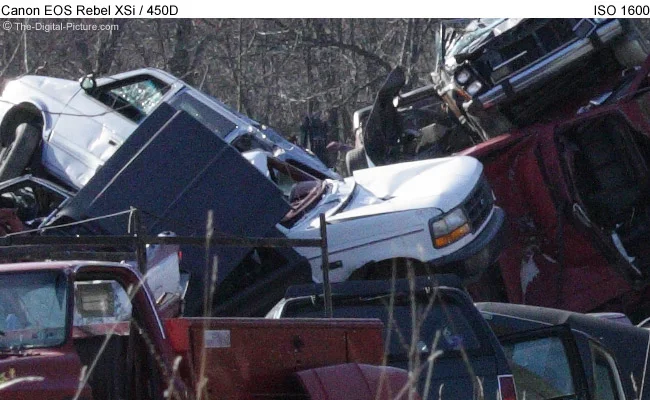
Above are near-center-of-the-frame crops from images shot in RAW format late in the afternoon on a clear day. The DSLR images were processed in Digital Photo Pro (included with all Canon Digital SLR cameras) using the Neutral Picture Style (flat, "0" contrast) and sharpness set to "1" (low). No noise reduction was used (available in-camera on the XSi / 450D). The EOS bodies were mounted on a Canon EF 70-200mm f/4 L IS USM Lens that was tripod collar-mounted to a solid tripod. An f/8 aperture was used on all cameras to minimize depth of field issues and maximize lens sharpness.
The 5D has the highest resolution sensor out of this group, so in a perfect comparison test, it should show details slightly larger than the XSi. The 1.6x body (XSi, XTi and 40D) samples were shot at 70mm which frames like 112mm. The 5D sample was taken at 111mm, so the details appear very slightly smaller in relation to the 1.6x samples. Whether the widest focal length of a zoom lens is an accurately rated focal length (is 70mm truly 70mm?) is a question for another day - it very well may be something slightly longer which also gives the 5D an additional slight disadvantage. Regardless, the comparison is close - the noise and color (from auto white balance) stand on their own.
The Canon PowerShot G9 RAW images were converted in Canon's Raw Image Task (DPP cannot open G9 RAW files). Saturation was decreased slightly (default was over-saturated in my opinion), but no other changes were made in RIT to process these images. Obviously, being a point and shoot, the G9 utilized its own lens. Finely controlling the focal length on this lens is not possible, so I settled on close for this one. The G9's resolution is very close to the XSi / 450D's - but its noise levels are not.
Following is another look at the noise topic.
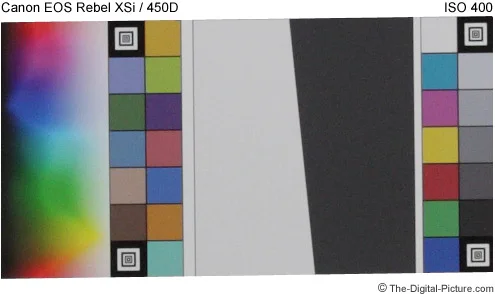
The above images were shot in the studio under daylight-balanced Tungsten lights using the same camera setup as the previous comparison example. In this example, all images are using identical exposure times and an f/5.6 aperture. The G9 shots are using the default saturation value in this comparison. Drag your mouse down through the links to see the noise change at various high ISO settings for one camera, or drag the mouse between cameras to see how they compare.
As expected, with its larger sensor with lower pixel density, the EOS 5D delivers the cleanest high ISO images. The EOS 40D and the XSi are very close to each other - even though the XSi has a more pixels packed into the same surface area of sensor. The XSi / 450D easily outperforms the XTi / 400D in this regard even at lower ISO settings - this is a nice upgrade.
The PowerShot G9 is regarded as one of the best point and shoot bodies currently available, but you probably don't want to use it for important shots at an ISO setting above 100. The image quality advantage of the Digital SLRs is one of the key reasons so many people are upgrading to them.
The XSi's AE (auto exposure) is matching very closely to the EOS 40D - which is very good. ISO sensitivity is also matching - which matches the trend we're seeing in Canon's recent DSLRs - slightly less sensitive ISO settings that appear to be more in line with industry standards. The XTi /400D is about 1/3 stop more sensitive than these two bodies across the ISO setting range. Overall, the XSi / 450D's image quality is excellent - and similar to that from the 40D.

Autofocus performance is always a key factor in selecting a DSLR. And the XSi gives us a nice improvement in this area. The comparison above shows what appears at first glance to be a similar 9 AF point layout in three EOS camera bodies. The body names are in fact positioned in ascending AF performance order (from left to right).
The DIGIC III processor gives the XSi / 450D's AF system an approximately 30% speed improvement over the XTi / 400D. In addition, the XSi / 450D is also able to recognize a larger amount of defocus with its slightly longer vertical component of the center focus point.
All three of these cameras have a cross-type (able to recognize contrast in two directions) center focus point (indicated in the illustrations above). All three require a lens with a maximum aperture opening of at least f/5.6 to autofocus and all three have a high-precision cross-type center focus point that kicks in with f/2.8 or faster lenses (EF or EF-S). The 40D differentiates itself in that all 9 AF points are cross-type and the center focus point is a high-precision cross-type in an X-shape (not shown in the comparison). The 40D is powered by the DIGIC III processor as well.
Putting numbers on the realized advantages between the three AF systems I've discussed here is not easy - and it will depend a lot on what the camera is used for. Single Shot AF is working very well and I'm getting many very nice shots in AI Servo mode tracking action. I am certain that I am getting better results with the XSi / 450D than I got from the XTi / 400D. I also feel that the 40D delivers slightly better results and that the 1-Series bodies are even better. All said, the XSi / 450D gives us a very competent autofocusing system - it is excellent for the price.
Did you see the round black circle in the XSi viewfinder image above? The XSi / 450D is the first camera in this series to have spot metering. Spot metering is useful when you want to base your exposure off of a small portion of what is in the frame - an approximately 4% center portion of the viewfinder.

A new use for the rear LCD ... Traditionally, the mirror, submirror and shutter in an SLR camera prevents the light coming through the lens from reaching the sensor before the picture is actually taken. The newer EOS DSLR models including the XSi / 450D (but not the XTi / 400D) have a feature called Live View. Live View allows the mirror to be raised and the shutter to be opened prior to the shot - clearing the path for light to reach the sensor. With light reaching the sensor, the camera is able to show the preview image on the rear LCD (obviously, the viewfinder goes dark during Live View). This is a very nice feature (one that grows on you when you are not used to having it available) - and even makes a histogram available for fine-tuning the exposure. Connect the camera to a PC or Mac and take full control from your keyboard, mouse and monitor.
The problem with Live View is that traditional (and very fast) phase detection autofocusing requires the mirror to be down so the submirror behind it can direct light into the autofocus sensor. The first implementations of Live View did not make provision for autofocusing while in Live View mode - either prefocusing or manual focusing was required.
Later implementation of Live View allowed quick focusing during Live View by turning off Live View (returning the mirror) long enough for traditional AF to take place. And the XSi / 450D has this option. The XSi / 450D adds contrast-detection AF to the available Live View AF modes. Contrast detection is the AF method used by point and shoot cameras such as the G9 referenced in this review. It is generally slow - and is painfully slow in the XSi / 450D's implementation. Expect 3 to 4 second focusing times (the G9 is usually much faster). Fast phase detection AF is one of the big reasons for using a DLSR, but having Live View and contrast detection AF gives us an additional option. Sorry, the XSi / 450D still does not record video (one of the primary reasons I own a Canon PowerShot G9).
HTP (Highlight Tone Priority) is another Canon feature that has made its way into the XSi / 450D. When custom function C.fn-5 is enabled, HTP "Improves the highlight detail. The dynamic range is expanded from the standard 18% gray to bright highlights. The gradation between the grays and highlights becomes smoother." [Canon Owner's Manual] I reviewed HTP in more depth for the Canon EOS-1DS Mark III review. When shooting in very high contrast situations, I more and more frequently turn to HTP to help save the highlight detail. This comes at the expense of some shadow noise (200 is the minimum ISO setting useable for HTP) and contrast may need to be increased in post processing for optimal results.
Another similarity that continues to emerge across the Canon EOS DSLR line is the user-friendly menu system. The XSi has inherited the very-similar tabbed menu seen in the 40D and Mark III bodies. The best tab in this menu is the "My Menu" tab where you can select the options you use most for quick access. For example, Canon's bodies do not have mirror lockup buttons, but this option saved in the "My Menu" is quickly accessible. Format is another frequently-used menu option that works well in this position.

Another menu option that made its way to the Canon EOS Rebel XSi / 450D is "Flash Control". Extensive control over the built-in flash or a compatible external flash (currently only the Canon Speedlite 580EX II Flash) is possible from this menu. While on the flash topic ... The XSi / 450D's hot shoe is now silver like the other late model Canon EOS bodies - but the base under the hot shoe is not shaped like the rest. To see this difference, look at the DSLR back comparison images with the 40D early in this review. The XSi / 450D is not weather sealed and does not accommodate the sealing at the flash. The 40D is partially weather sealed and accommodates the flash/hotshoe sealing feature.
Like the rest of Canon's recent DSLR introductions, the XSi has a self-cleaning sensor. Unlike most of my recent DSLR purchases, the XSi / 450D did not arrive with a dirty sensor out of the box. And I have not had dust problems even after thousands of pictures and lots of lens changes including outdoor changes. This is the way it should be - but often not the way it is.
To hear the frame rate difference, listen to a burst comparison between the XTi/400D, XSi/450D and 40D below.
Canon EOS XTi --> XSi --> 40D Burst Comparison
Canon EOS XSi / 450D 3.5fps Burst
Canon EOS XSi / 450D Single Shot
With the lens cap on (less detail = smaller file size), aperture wide open, a shutter speed of 1/4000 (max), ISO 100 selected and a SanDisk Extreme III 8GB SDHC card in the memory slot (no more CompactFlash memory), expect 6 RAW frames to rather-quietly fill the XSi / 450D buffer with one additional shot every .75 seconds. These are optimum settings for this test - a higher ISO setting or significantly longer shutter speed, for example, can slow frame rates. A frame rate of 3.5 fps is not going to set the world on fire, but it is not bad - the 5D's rate is even .5 fps slower.
At least somewhat surprising is that the XSi / 450D RAW buffer holds significantly fewer frames than even its predecessor did. The increased file size caused by the additional resolution and especially the 14-bit capture (up from 12 - delivers improved tonal gradation) is at least partially to blame for this. An 8GB card in the XTi / 400D formats to about 826 frames whereas an 8 GB card in the XSi / 450D formats to only 516 frames. Actual file sizes of XSi / 450D RAW images are about 6-10 MB larger - or about 15-22 MB each. JPG files are 8-bit and compressed which results in much smaller file sizes. When shooting JPGs, the XSi / 450D nearly doubles the number of continuously capturable frames of its predecessor.
Shutter lag and mirror blackout times are also compared in the above table. While the XSi / 450D's numbers are not dramatically shorter than the XTi / 400D's, the difference seems more significant to me. I felt the XTi / 400D shutter lag hindered me when shooting sports, but I'm not minding the XSi / 450D's shutter lag. The startup times on all of these cameras are are very fast - basically instant-on. Going from .2 to .1 sec is impressive if you look at the percentage difference, but in reality - it doesn't matter (to me at least).
The Canon EOS Rebel XSi / 450D employs a new battery - the LP-E5. This battery charges in about 2 hours in the included compact LC-E5 charger. A fully charged battery is rated for 600 shots or 500 with 50% built-in flash use. In Live View, expect only 200 shots. I did not test a full battery run down on this body, but I feel comfortable with the rated numbers based on my usage.

Want to double the number of shots without a battery change? Put two LP-E5 batteries in a Canon BG-E5 Battery Grip attached to the XSi / 450D. On the XTi / 400D, I found the battery grip to be really helpful for handling the camera. On the XSi / 450D, I like the battery grip a lot, but it is not as important to me now that my pinky fits on the standard grip. Shooting in portrait orientation is far easier with the battery grip.
| Model | Shutter Durability Rating |
|---|---|
| Canon EOS Rebel SL1 / 100D | n/a |
| Canon EOS Rebel T5i / 700D | n/a |
| Canon EOS Rebel T4i / 650D | n/a |
| Canon EOS Rebel T3i / 600D | n/a |
| Canon EOS Rebel T2i / 550D | n/a |
| Canon EOS Rebel T1i / 500D | 100,000 |
| Canon EOS Rebel T5 / 1200D | n/a |
| Canon EOS Rebel T3 / 1100D | n/a |
| Canon EOS Rebel XSi / 450D | 100,000 |
| Canon EOS Rebel XS / 1000D | 100,000 |
| Canon EOS Rebel XTi / 400D | 50,000 |
| Canon EOS Rebel XT / 350D | 50,000 |
| Canon EOS 70D | 100,000 |
| Canon EOS 60D | 100,000 |
| Canon EOS 50D | 100,000 |
| Canon EOS 40D | 100,000 |
| Canon EOS 30D | 100,000 |
| Canon EOS 20D | 50,000 |
| Canon EOS 7D | 150,000 |
| Canon EOS 6D | 100,000 |
| Canon EOS 5D Mark III | 150,000 |
| Canon EOS 5D Mark II | 150,000 |
| Canon EOS 5D | 100,000 |
| Canon EOS-1D X | 400,000 |
| Canon EOS-1D Mark IV | 300,000 |
| Canon EOS-1D Mark III | 300,000 |
| Canon EOS-1D Mark II N | 200,000 |
| Canon EOS-1Ds Mark III | 300,000 |
| Canon EOS-1Ds Mark II | 200,000 |
Canon is not disclosing the rated shutter life for the Canon EOS Rebel XSi / 450D. I'll let you make your own guess.
The XSi has proven to be a great DSLR, but is it the right choice for you? In my opinion, it is definitely worth the price difference over the prior Rebel / ***D models (which will likely remain available for a period of time) and is a great upgrade from even the best Canon point and shoot currently available - the PowerShot G9. That leaves higher priced models left for comparison - with the 40D at the top of the list.
The XSi has only been available for a short period of time and already my mailbox is filling with the question "Should I get the XSi / 450D or the 40D?" The same scenario occurred with the XTi / 400D and the 30D, but this time the question is harder to answer - the XSi / 450D delivers near-similar image quality. And this is a very legitimate question to ask. Why pay more money for the camera with a lower resolution sensor? Well, there is more to the answer than the number of pixels - which only provide an incremental benefit.
Actually, if these two bodies were priced identically, the 40D would be the right answer for most people, but they are not priced similarly. If you are serious about shooting action, the 40D is a better choice - It has a much higher frame rate, deeper buffer, better AF system, shorter shutter lag and a faster max shutter speed (1/8000 vs. 1/4000). If you need more-professional reliability, the 40D is probably the better choice - It is more rigidly built (magnesium alloy and stainless steel vs. stainless steel and polycarbonate), has partial weather sealing and *likely* has a longer shutter life. The 40D is faster to control with more top-mounted buttons, a rear control dial and a joystick. The 40D has a larger grip (for better control), has a larger pentaprism viewfinder (vs. pentamirror) and has a PC port for controlling studio lighting (the XSi / 450D requires a hot shoe adapter for this function).
The 40D has 24 custom functions while the XSi / 450D has 13. The 40D has ISO 3200 and Kelvin white balance settings available and has a top LCD. The 40D will flash synch up to 1/250 sec while the XSi / 450D tops out at 1/200 sec (both can utilize high speed synch for faster shutter speeds - but at a loss of power). The 40D has additional focusing screens available and supports WIFI and GPS.
To the XSi / 450D's advantage (aside from price) is a higher resolution sensor. It is a much smaller and lighter camera. The XSi / 450D can be controlled by the inexpensive Canon RC-1 and RC-5 Wireless Remotes. And, the XSi / 450D has (very slow) contrast detection AF in Live View.
Interesting is that the XSi has nearly as many pixels as the Canon EOS 5D - a much larger and more expensive full frame body. The one advantage full frame bodies have over 1.6x FOVCF bodies is that identical focal length lenses frame much wider - wide angles are very wide. However, put Canon's widest zoom lens (at the time of this writing) on a 1.6x body and compare it to Canon's widest full frame zoom lens on a full frame body. The angle of view delivered by these combinations is essentially identically.
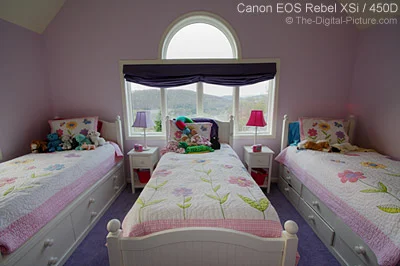
For the above sample pictures, the Canon EF-S 10-22mm f/3.5-4.5 USM Lens was mounted on the XSi and the Canon EF 16-35mm f/2.8 L USM Lens was mounted on the 5D in the above comparison. Both lenses were set to their widest focal lengths. Do not compare colors or lighting in this comparison as the ambient light changed between these shots.
Canon makes somewhat wider non-zoom full frame lenses and some third parties offer wider full frame zooms, so the 5D can go wider than the XSi / 450D, but we are talking extreme wide at these focal lengths. For these sample shots, my back was against the wall of this 11' deep and 16' wide room.
With the same subject framing, same subject distance and same aperture setting, the full frame 5D images are going to have a more diffusely blurred background. I really like this effect, but there are also times when it is not desirable. Aside from the full frame advantage (I consider it an advantage anyway), the 5D delivers better high ISO image quality and with its lower density sensor, often delivers sharper images (though possibly not in the corners).
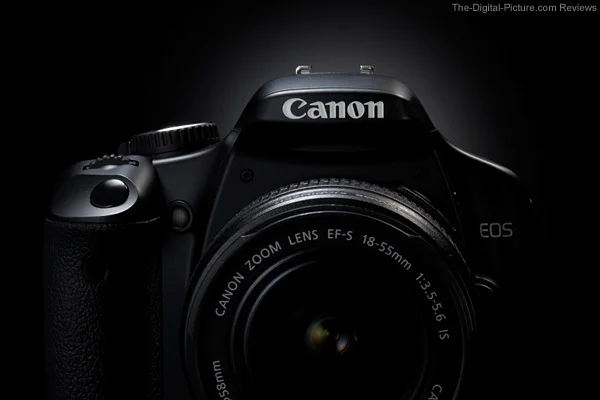
For an artistic view of the XSI/450D, hover your mouse over the links below.
I shoot in RAW format nearly 100% of the time - and all of my testing utilized RAW capture. I love the control I have when fine-tuning my RAW shots after the capture. But, you don't have to shoot RAW. With a huge range of control over all image aspects directly in the camera, you can tune your Canon EOS Rebel XSi / 450D to deliver exactly what you want in a JPG. Adjust Picture Style, color, saturation, contrast, white balance, noise reduction, sharpness ... to your preference.
And life doesn't get any simpler than the green square mode. Turn the mode selector dial to the fully automatic green square mode and the camera does all of the work and delivers a completed JPG image ready for printing, sharing or simply archiving. With slightly more effort, you can select a pre-programmed mode on the dial - and get better results (if the appropriate mode is selected of course). Or go all the way to the creative modes and have complete professional-grade control over your exposures. The beauty of this vast range of control is that a family/group with vastly differing photographic experience (or interest) can share the same camera. These features are not unique to the XSi / 450D (all of Canon's current non-1-Series bodies share them), but your skills are very likely covered somewhere in the XSi / 450D's available modes.
Like all other Canon EOS Digital SLR cameras, the XSi is compatible with a huge range of lenses and accessories. Deciding which lens to buy for the camera is the first decision to make - and this decision can be as hard or harder to make than deciding which camera to buy. The XSi / 450D is available in a kit with the Canon EF-S 18-55mm f/3.5-5.6 IS Lens or in a body only format. The kit lens is a good deal for the price - better lenses are available. You can start your lens research with my Canon Lens Recommendations or by simply browsing the Canon lens reviews on this site.
There is far more Canon EOS Rebel XSi / 450D information available than I covered in this review. See the links below for more in-depth information - read the owner's manual, read the brochure.
The number of people moving up to digital SLR cameras has been amazing - but so are the images these cameras can deliver. Even compared to the not-very-old Canon Rebel XTi/400D, the XSi/450D delivers better image quality from a more attractive body with more features ... I'm very pleased (actually somewhat surprised) with the improvements delivered by the Canon EOS Rebel XSi / 450D. It will be a worthwhile upgrade for many XTi / 400D owners - it is a lot of camera for the money.
Bringing you this site is my full-time job (typically 60-80 hours per week). Thus, I depend solely on the commissions received from you using the links on this site to make any purchase. I am grateful for your support! - Bryan


USA Press Release
Europe Press Release
Canon EOS Rebel XSi / 450D Owner's Manual (13.6 MB PDF)
Canon EOS Rebel XSi / 450D Brochure (.6 MB PDF)
Using XSi's Live View at The Canon Digital Learning Center
Enjoy! Digital SLR Cameras
Canon Camera Museum
Canon EOS Rebel XSi, XS, XTi Comparison Chart
Canon EOS Fall-Winter 2009 Catalog (8.4MB PDF)
Digital Workflow
Sensor Cleaning
Canon EOS System Catalog - Spring 2008
Steves-Digicams
CNET
LearnSLR.com


Review Date: 2008-04-16
« Canon EOS Rebel T3 / 1100D Review
» Canon EOS Rebel XS / 1000D Review


