
Canon EOS 5D Review


Want to create a new Digital SLR category? Take a Canon 20D, enlarge the mirror box, viewfinder, sensor and price - and you have a Canon EOS 5D - the smallest, lightest, full-frame Digital SLR available today. And with 12.8 megapixels of Canon CMOS resolution, the 5D offers excellent image quality at a great price.

The first thing a Canon 20D (above left) user will notice when picking up the 5D (above right) is the slightly larger body size. The first thing they will feel is the slightly larger and very comfortable grip. The smile will appear immediately when they put the large viewfinder to their eye.
The big full-frame viewfinder is a big asset to this camera. While not quite the 100% viewfinder found on the 1-Series Digital SLRs, the 5D's 96% viewfinder is very nice. Be sure to read the Field of View Crop Factor (FOVCF) page for more information on the advantages/disadvantages of the 5D's full-frame sensor. The following table illustrates sensor and viewfinder differences across the recent Canon Digital SLR models.
| Model | FOVCF | Sensor | Pixel Size | Pixels/Megapixels | Viewfinder | DLA* | ||
|---|---|---|---|---|---|---|---|---|
| Canon PowerShot G1 X | 1.9x | 18.7 x 14.0mm | 4.3µm | 4352 x 3264 | 14.3 | f/6.9 | ||
| Canon PowerShot G12 | 4.7x | 7.4 x 5.6mm | 2.7µm | 3648 x 2048 | 10.0 | f/4.3 | ||
| Canon PowerShot G9 | 4.7x | 7.6 x 5.7mm | 2.5µm | 4000 x 3000 | 12.1 | f/4.0 | ||
| Canon EOS M | 1.6x | 22.3 x 14.9mm | 4.3µm | 5184 x 3456 | 18.0 | f/6.8 | ||
| Canon EOS Rebel SL1 / 100D | 1.6x | 22.3 x 14.9mm | 4.3µm | 5184 x 3456 | 18.0 | .87x | 95% | f/6.8 |
| Canon EOS Rebel T5i / 700D | 1.6x | 22.3 x 14.9mm | 4.3µm | 5184 x 3456 | 18.0 | .85x | 95% | f/6.8 |
| Canon EOS Rebel T4i / 650D | 1.6x | 22.3 x 14.9mm | 4.3µm | 5184 x 3456 | 18.0 | .85x | 95% | f/6.8 |
| Canon EOS Rebel T3i / 600D | 1.6x | 22.3 x 14.9mm | 4.3µm | 5184 x 3456 | 18.0 | .85x | 95% | f/6.8 |
| Canon EOS Rebel T2i / 550D | 1.6x | 22.3 x 14.9mm | 4.3µm | 5184 x 3456 | 18.0 | .87x | 95% | f/6.8 |
| Canon EOS Rebel T1i / 500D | 1.6x | 22.3 x 14.9mm | 4.7µm | 4752 x 3168 | 15.1 | .87x | 95% | f/7.5 |
| Canon EOS Rebel T5 / 1200D | 1.6x | 22.3 x 14.9mm | 4.3µm | 5184 x 3456 | 18.0 | .80x | 95% | f/6.8 |
| Canon EOS Rebel T3 / 1100D | 1.6x | 22.2 x 14.7mm | 5.2µm | 4272 x 2848 | 12.0 | .80x | 95% | f/8.3 |
| Canon EOS Rebel XSi / 450D | 1.6x | 22.2 x 14.8mm | 5.2µm | 4272 x 2848 | 12.2 | .87x | 95% | f/8.3 |
| Canon EOS Rebel XS / 1000D | 1.6x | 22.2 x 14.8mm | 5.7µm | 3888 x 2592 | 10.1 | .81x | 95% | f/9.1 |
| Canon EOS Rebel XTi / 400D | 1.6x | 22.2 x 14.8mm | 5.7µm | 3888 x 2592 | 10.1 | .80x | 95% | f/9.1 |
| Canon EOS Rebel XT / 350D | 1.6x | 22.2 x 14.8mm | 6.4µm | 3456 x 2304 | 8.0 | .80x | 95% | f/10.2 |
| Canon EOS 300D Digital Rebel | 1.6x | 22.7 x 15.1mm | 7.4µm | 3088 x 2056 | 6.3 | .80x | 95% | f/11.8 |
| Canon EOS 70D | 1.6x | 22.5 x 15.0mm | 4.1µm | 5472 x 3648 | 20.2 | .95x | 98% | f/6.6 |
| Canon EOS 60D | 1.6x | 22.3 x 14.9mm | 4.3µm | 5184 x 3456 | 18.0 | .95x | 96% | f/6.9 |
| Canon EOS 50D | 1.6x | 22.3 x 14.9mm | 4.7µm | 4752 x 3168 | 15.1 | .95x | 95% | f/7.5 |
| Canon EOS 40D | 1.6x | 22.2 x 14.8mm | 5.7µm | 3888 x 2592 | 10.1 | .95x | 95% | f/9.1 |
| Canon EOS 30D | 1.6x | 22.5 x 15.0mm | 6.4µm | 3504 x 2336 | 8.2 | .90x | 95% | f/10.2 |
| Canon EOS 20D | 1.6x | 22.5 x 15.0mm | 6.4µm | 3504 x 2336 | 8.2 | .90x | 95% | f/10.2 |
| Canon EOS 10D | 1.6x | 22.7 x 15.1mm | 7.4µm | 3088 x 2056 | 6.3 | .88x | 95% | f/11.8 |
| Canon EOS 7D | 1.6x | 22.3 x 14.9mm | 4.3µm | 5184 x 3456 | 18.0 | 1.0x | 100% | f/6.9 |
| Canon EOS 6D | 1.0x | 35.8 x 23.9mm | 6.54µm | 5472 x 3648 | 20.2 | .71x | 97% | f/10.5 |
| Canon EOS 5D Mark III | 1.0x | 36.0 x 24.0mm | 6.25µm | 5760 x 3840 | 22.3 | .71x | 100% | f/10.1 |
| Canon EOS 5D Mark II | 1.0x | 35.8 x 23.9mm | 6.4µm | 5616 x 3744 | 21.1 | .71x | 98% | f/10.2 |
| Canon EOS 5D | 1.0x | 35.8 x 23.9mm | 8.2µm | 4368 x 2912 | 12.8 | .71x | 96% | f/13.2 |
| Canon EOS-1D X | 1.0x | 36.0 x 24.0mm | 6.9µm | 5184 x 3456 | 18.1 | .76x | 100% | f/11.0 |
| Canon EOS-1D Mark IV | 1.3x | 27.9 x 18.6mm | 5.7µm | 4896 x 3264 | 16.1 | .76x | 100% | f/9.1 |
| Canon EOS-1D Mark III | 1.3x | 28.1 x 18.7mm | 7.2µm | 3888 x 2592 | 10.1 | .76x | 100% | f/11.5 |
| Canon EOS-1D Mark II N | 1.3x | 28.7 x 19.1mm | 8.2µm | 3520 x 2336 | 8.2 | .72x | 100% | f/13.2 |
| Canon EOS-1D Mark II | 1.3x | 28.7 x 19.1mm | 8.2µm | 3520 x 2336 | 8.2 | .72x | 100% | f/13.2 |
| Canon EOS-1Ds Mark III | 1.0x | 36.0 x 24.0mm | 6.4µm | 5616 x 3744 | 21.1 | .76x | 100% | f/10.2 |
| Canon EOS-1Ds Mark II | 1.0x | 36.0 x 24.0mm | 7.2µm | 4992 x 3328 | 16.6 | .70x | 100% | f/11.5 |
To accommodate the larger viewfinder, mirror box and sensor, a body size slightly larger than the 20D's was required. Most of the 5D's additional size is in the chunkier center of the body. The built-in flash was sacrificed in this design. The table below compares the size and weight of some current-at-this-time Canon Digital SLR cameras.
| Model | Body Dimensions | CIPA Weight | |
|---|---|---|---|
| Canon PowerShot G1 X | 4.6 x 3.2 x 2.6" | (116.7 x 80.5 x 64.7mm) | 18.8 oz (534g) |
| Canon PowerShot G12 | 4.4 x 3.0 x 1.9" | (112.1 x 76.2 x 48.3mm) | 13.7 oz (389g) |
| Canon PowerShot G9 | 4.2 x 2.8 x 1.7" | (106.4 x 71.9 x 42.5mm) | 12.9 oz (365g) |
| Canon EOS M | 4.3 x 2.6 x 1.3" | (108.6 x 66.5 x 32.3mm) | 10.5 oz (298g) |
| Canon EOS Rebel SL1 / 100D | 4.6 x 3.6 x 2.7" | (116.8 x 90.7 x 69.4mm) | 14.4 oz (407g) |
| Canon EOS Rebel T5i / 700D | 5.2 x 3.9 x 3.1" | (133.1 x 99.8 x 78.8mm) | 20.5 oz (580g) |
| Canon EOS Rebel T4i / 650D | 5.2 x 3.9 x 3.1" | (133.1 x 99.8 x 78.8mm) | 20.3 oz (575g) |
| Canon EOS Rebel T3i / 600D | 5.2 x 3.9 x 3.1" | (133.1 x 99.5 x 79.7mm) | 20.1 oz (570g) |
| Canon EOS Rebel T2i / 550D | 5.1 x 3.8 x 2.4" | (128.8 x 97.5 x 61.9mm) | 18.7 oz (530g) |
| Canon EOS Rebel T1i / 500D | 5.1 x 3.8 x 2.4" | (128.8 x 97.5 x 61.9mm) | 18.6 oz (527g) |
| Canon EOS Rebel T5 / 1200D | 5.1 x 3.9 x 3.1" | (129.6 x 99.7 x 77.9 mm) | 16.9 oz (480g) |
| Canon EOS Rebel T3 / 1100D | 5.1 x 3.9 x 3.1" | (129.9 x 99.7 x 77.9mm) | 17.5 oz (495g) |
| Canon EOS Rebel XSi / 450D | 5.1 x 3.8 x 2.4" | (128.8 x 97.5 x 61.9mm) | 18.4 oz (522g) |
| Canon EOS Rebel XS / 1000D | 5.0 x 3.8 x 2.4" | (126.1 x 97.5 x 61.9mm) | 17.5 oz (497g) |
| Canon EOS Rebel XTi / 400D | 5.0 x 3.7 x 2.6" | (127 x 94 x 65mm) | 19.9 oz (564g) |
| Canon EOS Rebel XT / 350D | 5.0 x 3.7 x 2.6" | (127 x 94 x 64mm) | 19.0 oz (539g) |
| Canon EOS 70D | 5.5 x 4.1 x 3.1" | (139.0 x 104.3 x 78.5mm) | 26.7 oz (755g) |
| Canon EOS 60D | 5.7 x 4.2 x 3.1" | (144.5 x 105.8 x 78.6mm) | 26.6 oz (755g) |
| Canon EOS 50D | 5.7 x 4.2 x 2.9" | (145.5 x 107.8 x 73.5mm) | 29.1 oz (826g) |
| Canon EOS 40D | 5.7 x 4.4 x 2.9" | (145.5 x 112 x 73.5mm) | 29.5 oz (836g) |
| Canon EOS 30D | 5.7 x 4.2 x 2.9" | (144 x 105.5 x 73.5mm) | 28.1 oz (796g) |
| Canon EOS 20D | 5.6 x 4.2 x 2.8" | (144 x 106 x 72mm) | 27.5 oz (781g) |
| Canon EOS 7D | 5.8 x 4.4 x 2.9" | (148.2 x 110.7 x 73.5mm) | 32.2 oz (914g) |
| Canon EOS 6D | 5.7 x 4.4 x 2.8" | (144.5 x 110.5 x 71.2mm) | 26.6 oz (755g) |
| Canon EOS 5D Mark III | 6.0 x 4.6 x 3.0" | (152 x 116.4 x 76.4mm) | 33.5 oz (950g) |
| Canon EOS 5D Mark II | 6.0 x 4.5 x 3.0" | (152 x 113.5 x 75mm) | 31.9 oz (904g) |
| Canon EOS 5D | 6.0 x 4.4 x 3.0" | (152 x 113 x 75mm) | 32.0 oz (906g) |
| Canon EOS-1D X | 6.2 x 6.4 x 3.3" | (158 x 163.6 x 82.7mm) | 54.0 oz (1530g) |
| Canon EOS-1D Mark IV | 6.1 x 6.2 x 3.1" | (156 x 157 x 80mm) | 48.5 oz (1374g) |
| Canon EOS-1D Mark III | 6.1 x 6.2 x 3.1" | (156 x 157 x 80mm) | 47.6 oz (1349g) |
| Canon EOS-1D Mark II N | 6.1 x 6.2 x 3.1" | (156 x 158 x 80 mm) | 55.5 oz (1574g) |
| Canon EOS-1Ds Mark III | 6.1 x 6.3 x 3.1" | (156 x 159.6 x 79.9mm) | 49.5 oz (1404g) |
| Canon EOS-1Ds Mark II | 6.1 x 6.2 x 3.1" | (156 x 158 x 80 mm) | 55.2 oz (1564g) |
Keep in mind that the 1-Series bodies above have an integrated portrait grip that adds to their base weight. The BG-E4 Battery Grip brings the 5D's weight closer to the 1-Series models. Many will appreciate the versatility provided by a removable grip. Without the grip, the 5D is very comfortable to hold - noticeably better than the 20D in my opinion. Good indentations are provided for the thumb and second finger. The deep grip hangs onto fingers well. As always, a picture is worth a thousand words ...

Above are the Canon EOS 20D (left) and the Canon EOS 5D (right). Aside from the slight size difference, they are very similar. Notice the finger grove on the 5D.
Overall, the Canon EOS 5D's build quality is excellent. The rugged body is composed of a magnesium alloy and stainless steel chassis (including the optional BG-E4 Battery Grip). Although this is not a dust and weather sealed design, the feel is solid and sure. Next to the 1-Series bodies, this is my favorite Canon grip thus far. A sculpted Canon logo, electroplated “EOS 5D” badge and higher density matte finish complete the quality look and feel.
Differentiating the 5D from many of Canon's other mid and high end Digital SLRs is the relatively slow 3 fps continuous shooting drive mode. However, a large image buffer allows the 5D to keep shooting for a long time. Keep in mind that rated fps requires shutter speeds of 1/250 sec. or faster (this requirement is not unique to the 5D). Compare ...
Durability-tested to 100,000 exposures, the 5D's shutter should last through twice as many actuations as the 20D - or half as many as the 1-Series bodies. Shutter speeds range from 1/8000 to 30 sec. (in 1/3-stop increments) plus Bulb. X-sync is at a somewhat slow 1/200 sec. (higher shutter speed synch is generally made available by the flash).
The 5D is one of the quietest Canon DSLRs currently available. Listen to the 5D's shutter sound and frame rate compared to the Canon 20D ...
5D 3 fps Burst
20D 5 fps Burst
Canon EOS 5D Single Shot
Canon 20D Single Shot
The Canon EOS 5D is equipped with a newly developed 9-point AF unit with 6 invisible Supplemental AF points. Results include improved AI Servo AF subject tracking and improved focusing from a defocused state. I find the 5D's autofocus to be both fast and accurate - even in low light situations. Although not quite as good as the 1D Mark II and 1Ds Mark II, the 5D performs well for real AF challenges such as action sports photography. My AI Servo AF hit rate through several soccer games was slightly less than what I generally see with the 1Ds Mark II, but still very good.
The 9 AF points span approximately the same subject area as Canon's other Digital SLRs. Like the 20D, the 5D requires a lens with a maximum aperture opening of at least f/5.6 for AF to function. Canon's 1-Series bodies can AF with a maximum aperture of at least f/8 (1-stop less). All modern lenses have 5D AF-compatible apertures - the difference comes when adding extenders to these lenses. To learn more about the 5D's AF technology, read the white paper (link below).
The Canon EOS 5D's Image quality is excellent. This should be a surprise to none. As a broad statement, I would say that the 5D's image quality falls between the 20D and the Canon EOS-1DS Mark II - more because of the number of pixels than anything else. Dynamic range is good, but appears to be slightly closer to the 20D than the 1Ds Mark II.
The 5D expands the 20D's ISO 100 to 1600 to include ISO 50 and 3200. In addition, the 5D allows 1/3 increment stops. Noise performance is similar to the 1-Series Mark II bodies and very slightly better than the 20D.
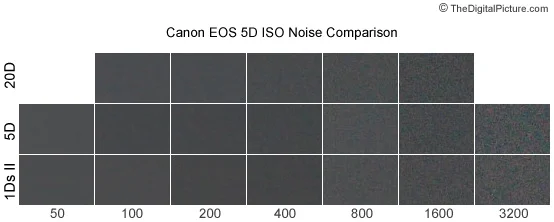
The above noise comparison clips were taken from a color with very apparent noise. Many subjects will show far less noise than these samples do. The set of ISO 1600 clips below attempt to show some of the difference I am referring to.

The 5D's AE (Auto Exposure) works as expected - very well in my opinion. The 5D shares the 20D's +/- 2 EV under/over exposure control (the 1-Series' +/- 3 EV would have been nice). Single Spot Metering (3.5% at center) has been added to the 5D as well as the 20D's list of metering modes.
New this round are Picture Styles. Picture Styles are said to simulate the qualities of various film types by adjusting sharpness, color tone, contrast and sharpness. The six preset Picture Style settings include Standard, Portrait, Landscape, Neutral, Faithful and Monochrome. Three user-defined options are available as well. Apparently, most of these films are not ones I want to use. I may adjust to them; but thus far, I am not too excited about the preset settings. The one exception may be the Landscape Picture Style that appears to emulate Fuji's Velvia Film. And neutral of course - the setting I am using in-camera. I say in-camera as Picture Styles settings can be changed in post-process using the included Digital Photo Pro software. In fact, RAW files from cameras as old as the Canon D30 can be processed using the new Picture Styles. The ability to create your own User-Defined Picture Styles is great. Mix up your own parameters to perfection. In addition, Canon's Picture Styles web site provides additional downloadable Picture Styles for use in-camera or in DPP.

I think a 2.5" LCD was overdue for this class of camera, but I wouldn't have put this feature at the top of my wish list. The 1.8" LCD on the 20D (above left) was fine with me, but now that I have used a 2.5" (on 5D above right), I like it - more than I thought I would. While viewable at angles up to 170° (impressive), the 230,000 pixel LCD is too dim in bright sunlight. The larger menu text is easier to read (unless it is displayed in bright sunlight of course), image review is very nice. The LCD's color and contrast are good. An RGB Histogram is also available.
Canon 20D users will feel right at home with the 5D as it has inherited most of the menu navigation and button functionality. Slight differences exist - but few are significant in my opinion.
One such insignificant-to-me change is the addition of a print button.
The 5D's features and functions are extensive - there are very few pro or prosumer functions not included. I will leave the complete list to the retailers and Canon's white paper (linked below), but will touch on a few additional ones - especially differences between the 5D and the 20D.
The 5D has far fewer shooting modes than the 20D. With the exception of the Full Auto (point and shoot) mode, all of the basic modes (Portrait, Landscape ...) have been removed. Most people moving to a camera as advanced as the 5D do not use these modes anyway. New on the mode dial is a new 'C' (Camera User Setting) selection. Setup the 5D for a certain situation and save the settings (including custom functions - which include mirror lockup) to 'C'. When you want to immediately recall these settings, simply turn the mode dial to 'C'. Be wary of powering down the camera - or having it go into sleep mode - while in 'C' Mode. The camera likely will revert to the stored 'C' Mode settings even if you have altered them prior to power down/sleeping.
The 5D has 3 interchangeable focusing screens available. Most users will stay with the standard focusing screen, but this option will be important to some.
The 5D adds user selectable folders. This is a nice option for those who want to organize their shots into specific folders. Create a new folder, select it and begin shooting. Do the same again for the next set of shots you wish to keep grouped together.
New image viewing jump options are available on the 5D. You can jump by 10 or 100 images, by date or by folder. This makes finding a specific shot easier.
The 5D's full-frame sensor is certainly one of it's biggest selling points. Photographers have been asking for an affordable full-frame Digital SLR since DSLRs were first produced. Landscape and other wide angle photography needs are better met by a full-frame body. Portrait photographers want the shallow depth of field attainable with the larger sensor. The 5D is Canon's answer to these needs. Although it will be a long time before the goal is realized, Canon plans for all but the least expensive DSLRs to have full-frame sensors in the future.
Like the 20D, the 5D is powered by a Canon BP-511A Battery Pack. With a fully charged BP-511A (or BP-514), Canon indicates battery life at approximately 800 shots at 68°F (20°C) or 400 shots at 32°F (0°C). My first fully charged battery delivered 743 shots in my normal use, my second delivered about 800 shots. This includes a 4 second shot review, a fair amount of image reviewing and a lot of powered-on-but-idle time over 2+ weeks.
I have a heard a fair amount of complaining about the "poor" battery life of the 5D. What may not be understood is that there can be many shots left when the battery low indicator shows. Those without a spare battery or those who can't have the battery die at an uncertain moment use this indicator to recharge/replace the battery. The low battery indicator first showed after about 400 shots, the low battery indicator began flashing at around 600 shots. The battery went on working for another 143 shots for a respectable 743 total shots. That is a lot of pictures from a small, light battery. The optional battery grip allows two batteries to be used simultaneously for approximately double the number of shots from the 5D.
Power performance from the Canon EOS 5D is excellent. Power-on seems instant and all features and functions are responsive. Playback performance is very good as well. The 20D and 5D also share the same CB-5L battery charger. I appreciate the compact design of this 90 minute charger.

The 5D fits nicely in the Lowepro Toploader 65 AW (as long as the lens size is compatible) but the fit is very snug when the BG-E4 is mounted as pictured above.
So, who is going to buy the Canon EOS 5D?
The 5D will appeal to both advanced amateurs and professionals who need or want very high image quality, wide angle field of view and/or shallow depth of field but do not require a high continuous frame rate, durability or weather and dust sealing. Those needing higher frame rates (typically sports and sometimes wildlife photographers) should consider the Canon EOS 20D or the Canon EOS-1D Mark II N as alternatives. Those wanting the ultimate image quality should consider the Canon EOS-1DS Mark II - an incredible camera (See crop comparison page in the more reviews section below).
The Canon EOS 5D represents a great value in a high quality, high performance, full-frame Digital SLR. You get excellent quality, high resolution images for less money than ever before. I found very little to critique or complain about. This camera will exceed the requirements of many photographers.
For more information on and more pictures of the 5D, I highly recommend downloading Canon's white paper (in the more reviews section below).
Bringing you this site is my full-time job (typically 60-80 hours per week). Thus, I depend solely on the commissions received from you using the links on this site to make any purchase. I am grateful for your support! - Bryan


Canon EOS 5D / Canon EOS-1Ds Mark II Comparison Crops
Canon EOS 5D Press Release
Canon EOS 5D Press Release (UK)
Canon EOS 5D White Paper (1.37 MB PDF)
Canon EOS 5D Owner's Manual (4.5 MB .PDF)
Canon's Full-Frame CMOS White Paper (1.1 MB .PDF file)
Canon's 5D Site
Canon Camera Museum Technical Report
Canon EOS System Catalog - Spring 2008 (11.5 MB PDF)
Canon EOS System Catalog - Fall 2007 (16.7 MB PDF)
Canon EOS 20th Anniversary
Digital Workflow
Sensor Cleaning


